
Pharmacy Abbreviations & Sig Codes: 159 Meanings
Updated
Sig codes are the shorthand prescribers use to communicate directions, and translating them accurately is a core pharmacy technician task the PTCE tests directly. This reference lists 159 abbreviations across 5 categories, including the ISMP error-prone abbreviations you should never use on a label. Sig codes are tested in PTCB Order Entry & Processing, while those error-prone abbreviations belong to PTCB Patient Safety & Quality Assurance. When you are ready, test yourself with our free abbreviations quiz.
Download the abbreviations reference (PDF)Reading a sig: worked example
1 tab PO BID translates as: one tablet (tab), by mouth (PO), twice a day (BID). Build the habit of translating the whole sig into plain English before you calculate anything.
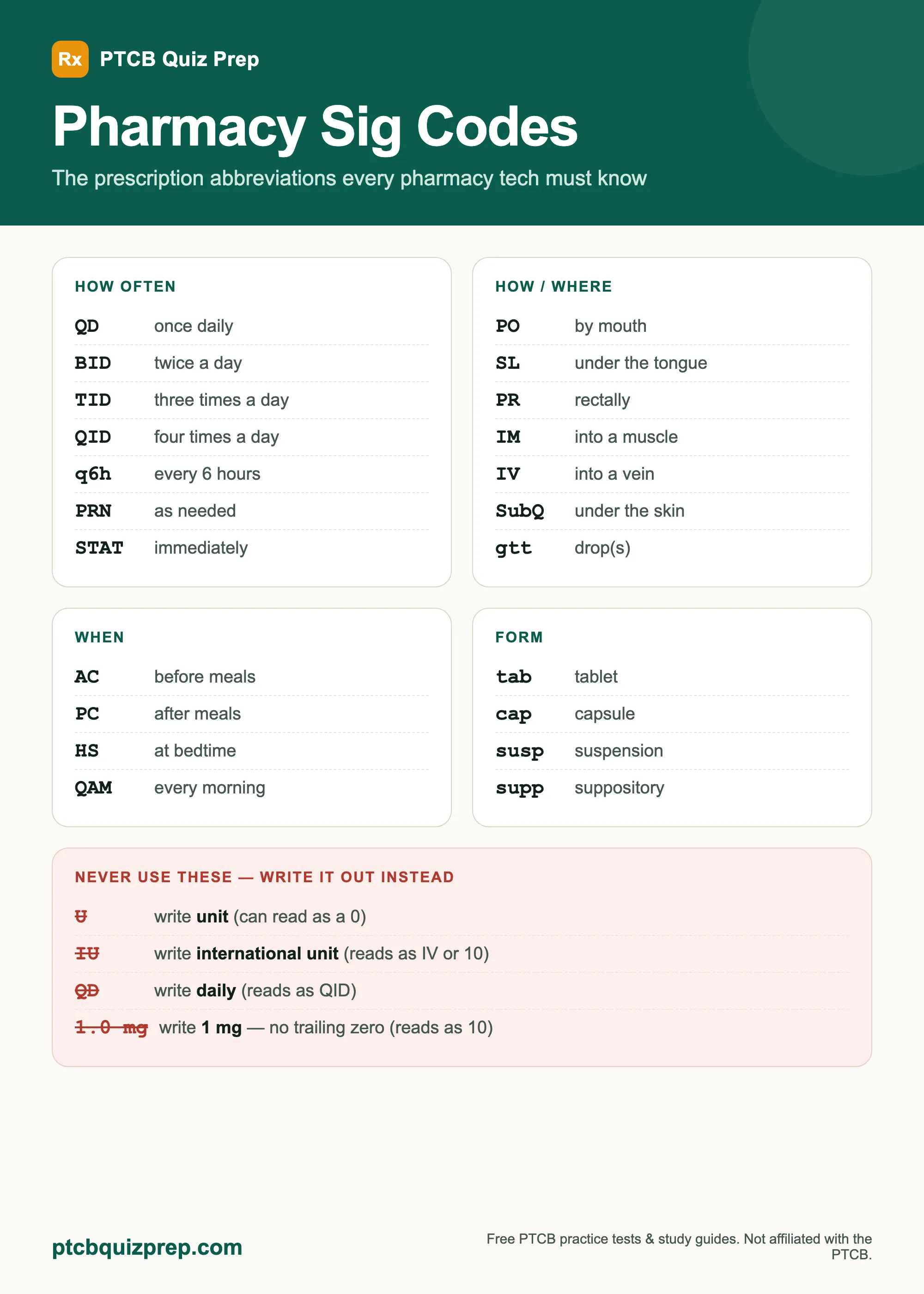
Time & Frequency
| Sig code | Meaning / safety note |
|---|---|
| ad lib | freely, as much or as often as the patient wantsFrom Latin ad libitum; used when the order sets no fixed limit. |
| ATC | around the clockDoses are given at set intervals through the full 24 hours, day and night. |
| bid | twice a dayFrom bis in die; the two doses are usually spaced about 12 hours apart. |
| tid | three times a dayFrom ter in die; commonly spaced roughly every 8 hours during waking hours. |
| qid | four times a dayFrom quater in die; do not confuse with qd (daily) or qod (every other day). |
| q | everyPlaced before a number and time unit, as in q8h meaning every 8 hours. |
| qh | every hourFrom quaque hora; a number can be added, so q1h means every 1 hour. |
| q1h | every 1 hourThe number can be swapped, so q3h means every 3 hours. |
| q2h | every 2 hours |
| q4h | every 4 hours |
| q6h | every 6 hours |
| q8h | every 8 hours |
| q12h | every 12 hours |
| ac | before mealsFrom ante cibum; the dose is taken shortly before eating. |
| pc | after mealsFrom post cibum; often used to lessen stomach upset by dosing after food. |
| hs | at bedtimeFrom hora somni; ISMP advises writing 'bedtime' because hs is also read as half-strength. |
| qhs | every night at bedtimeError-prone; can be misread as qhr (every hour), so spell out 'nightly'. |
| prn | as neededFrom pro re nata; a good order also states the reason and a minimum interval, as in prn pain q6h. |
| stat | immediately, right nowFrom statim; signals a single urgent dose to be given without delay. |
| qam | every morningAlso written qAM; means one dose each morning. |
| qpm | every eveningAlso written qPM; means one dose each evening. |
| ud | as directedFrom ut dictum; ISMP flags it because it can be misread as 'unit dose', so spell out 'as directed'. |
| noct | at nightFrom nocte. |
| am | morning, before noonFrom ante meridiem. |
| pm | afternoon or eveningFrom post meridiem. |
| tiw | three times a weekError-prone; easily confused with three times a day, so write '3 times weekly'. |
| qwk | once a week |
| sos | one dose if neededFrom si opus sit; a single dose given only if the situation requires it. |
| alt h | every other hourFrom alternis horis. |
| tds | three times a dayFrom ter die sumendum; a UK-style order equal to tid. |
| qds | four times a dayFrom quater die sumendus; a UK-style order equal to qid. |
| x | for (a stated duration)As in 'x 10 d' meaning for 10 days; avoid the run-together form x3d, which reads as 3 doses. |
Route & Dosage Form
| Sig code | Meaning / safety note |
|---|---|
| PO | by mouth, orallyFrom per os; PO or 'by mouth' is preferred because the 'os' alone can be misread as 'left eye'. |
| SL | under the tongue (sublingual)The tablet dissolves under the tongue and is absorbed there rather than swallowed. |
| buccal | between the cheek and gumSometimes shortened to BUC; the dose dissolves against the inside of the cheek. |
| PR | rectally, by rectumUsed for suppositories, enemas, and rectal solutions. |
| PV | vaginallyFrom per vagina; also written 'vag'. Used for vaginal tablets, creams, and rings. |
| IM | into a muscle (intramuscular) |
| IV | into a vein (intravenous) |
| IVP | intravenous pushThe dose is injected into the vein over a short, controlled time. |
| IVPB | intravenous piggybackA small IV bag infused through a port on an existing IV line. |
| subcut | under the skin (subcutaneous)ISMP prefers 'subcut'; the older forms SQ and SC are error-prone and discouraged. |
| ID | into the skin (intradermal)A shallow injection; can be misread as IV or IM, so 'intradermal' is safer. |
| IN | into the nose (intranasal)IN can be misread as IM or IV, so write 'intranasal' or NAS. |
| top | applied to the skin surface (topical) |
| TD | through the skin over time (transdermal)Describes patches that release drug slowly, as with a transdermal patch. |
| INH | inhaled, breathed into the lungsRefers to the inhaled route; do not confuse with isoniazid, a drug also abbreviated INH. |
| neb | given by nebulizerLiquid medicine is turned into a fine mist and breathed in. |
| AD | right earFrom auris dextra; ISMP flags ear codes because AD, AS, and AU are confused with the eye codes OD, OS, and OU. |
| AS | left earFrom auris sinistra; spelling out 'left ear' avoids ear and eye mix-ups. |
| AU | each ear, both earsFrom auris utraque. |
| OD | right eyeFrom oculus dexter; OD is also misread as 'once daily', so many prescribers spell out 'right eye'. |
| OS | left eyeFrom oculus sinister. |
| OU | each eye, both eyesFrom oculus uterque. |
| NG | through a nasogastric tubeA tube passed from the nose to the stomach used to give medicine or feeding. |
| tab | tablet |
| cap | capsule |
| susp | suspensionA liquid holding solid particles that settle, so it must be shaken before each dose. |
| sol | solutionAlso written soln; a clear liquid with the drug fully dissolved. |
| elix | elixirA sweet, flavored liquid that usually contains some alcohol. |
| syr | syrupA thick, sugary liquid base for oral medicines. |
| supp | suppositoryA solid dose that melts after insertion into the rectum, vagina, or urethra. |
| ung | ointmentFrom unguentum; a greasy, oil-based semisolid. |
| cr | creamAlso written crm; a water-based semisolid that rubs in more easily than an ointment. |
| lot | lotionA thin, pourable liquid for spreading over the skin. |
| gtt | drop (gtts means drops)From gutta; used for eye, ear, and nose liquids. |
| troche | lozenge (troche)A solid piece that dissolves slowly in the mouth. |
| EC | enteric-coatedA coating that lets the tablet pass the stomach and dissolve in the intestine; do not crush. |
| DR | delayed-releaseReleases the drug later than a plain form, often past the stomach. |
| ER | extended-releaseReleases the drug slowly over time; usually do not crush or chew. |
| XR | extended-releaseSame idea as ER; appears in brand names to signal slow release. |
| XL | extended-releaseAnother slow-release label; do not crush. |
| SR | sustained-releaseReleases the drug gradually to keep blood levels steadier. |
| CR | controlled-releaseDesigned to release the drug at a set, steady rate. |
| IR | immediate-releaseReleases the full dose right away, unlike ER, SR, or CR forms. |
| inj | injection |
| MDI | metered-dose inhalerA pressurized inhaler that delivers one measured puff per actuation. |
| pulv | powderFrom pulvis; a dry form that may be mixed or reconstituted before use. |
Measurement & Quantity
| Sig code | Meaning / safety note |
|---|---|
| mg | milligramOne thousandth of a gram; the most common strength unit on labels. |
| mcg | microgramOne thousandth of a milligram; use 'mcg', never the symbol that reads as mg. |
| g | gramSometimes written 'gm', but plain 'g' is the preferred abbreviation. |
| kg | kilogramEqual to 1,000 grams; used for weight-based dosing calculations. |
| mL | milliliterOne thousandth of a liter; about 5 mL equals one teaspoonful. |
| L | liter |
| cc | cubic centimeterEqual to 1 mL, but ISMP flags 'cc' because it is misread as 'u' (units); use mL. |
| gr | grainAn old apothecary unit of about 65 mg; easily confused with 'g' for gram, so use metric units. |
| tsp | teaspoonfulAbout 5 mL; patients should measure with a dosing syringe or cup, not a kitchen spoon. |
| tbsp | tablespoonfulAbout 15 mL, equal to three teaspoonfuls. |
| oz | ounceA fluid ounce is about 30 mL. |
| lb | poundAbout 0.45 kg; weight is often converted to kilograms for dosing. |
| mEq | milliequivalentA unit of chemical activity used for electrolytes such as potassium. |
| mmol | millimoleA unit of amount used for some electrolytes and laboratory values. |
| IU | international unitA standardized activity unit for vitamins and biologics; write it out because IU is error-prone. |
| qs | a sufficient quantityFrom quantum satis; add enough of an ingredient to reach the target amount. |
| qs ad | add enough to make up toAdd the base until the total volume or weight stated in the order is reached. |
| aa | of eachFrom ana; use the same amount of each listed ingredient. |
| BSA | body surface areaCalculated from height and weight; used to dose many chemotherapy drugs. |
| dil | diluteAn instruction to thin a preparation with a stated liquid. |
| # | number, or dispense this manyThe # sign before a number shows the quantity to dispense, as in #30. |
| dr | dramAn old apothecary unit of about 5 mL; its symbol is misread as the number 3, so use metric units. |
| ss | one-half (apothecary)Error-prone; can be mistaken for '55', so write 'one-half' or use the fraction. |
Common Drug & Term Abbreviations
| Sig code | Meaning / safety note |
|---|---|
| APAP | acetaminophenFrom N-acetyl-para-aminophenol; ISMP recommends spelling out 'acetaminophen' since APAP is not widely recognized. |
| ASA | aspirin (acetylsalicylic acid) |
| HCTZ | hydrochlorothiazideA thiazide water pill; can be confused with hydrocortisone (HCT), so the full name is safer. |
| KCl | potassium chlorideA potassium supplement; written as a salt to keep the meaning clear. |
| NTG | nitroglycerinUsed for chest pain; spelling out the full name avoids mix-ups with other drips. |
| MOM | milk of magnesiaA magnesium-based antacid and laxative. |
| NS | normal saline (0.9% sodium chloride) |
| D5W | dextrose 5% in waterA common IV sugar solution. |
| LR | lactated Ringer'sAn IV fluid that supplies several electrolytes. |
| TPN | total parenteral nutritionComplete IV nutrition given when the gut cannot be used. |
| NSAID | nonsteroidal anti-inflammatory drugIncludes ibuprofen and naproxen. |
| SSRI | selective serotonin reuptake inhibitorA class of antidepressants such as sertraline and fluoxetine. |
| SNRI | serotonin and norepinephrine reuptake inhibitorAntidepressants such as duloxetine and venlafaxine. |
| PPI | proton pump inhibitorLowers stomach acid; examples include omeprazole and pantoprazole. |
| ACEI | angiotensin-converting enzyme inhibitorBlood pressure drugs whose generic names end in -pril. |
| ARB | angiotensin receptor blockerBlood pressure drugs whose generic names end in -sartan. |
| CCB | calcium channel blockerBlood pressure and heart-rate drugs such as amlodipine and diltiazem. |
| BB | beta blockerHeart and blood pressure drugs whose generic names end in -olol. |
| ABX | antibiotics |
| HRT | hormone replacement therapy |
| Rx | prescription, or 'take'From the Latin recipe, meaning 'take'; marks a medication order. |
| OTC | over the counterMedicines that can be bought without a prescription. |
| DAW | dispense as writtenTells the pharmacy to supply the exact product ordered and not substitute a generic. |
| NDC | National Drug CodeA unique number identifying a drug's maker, product, and package size. |
| Sig | directions for the patientFrom signa; the part of the order that becomes the printed label instructions. |
| disp | dispenseShows how much of the drug to give the patient. |
| dtd | give this many dosesFrom dentur tales doses; tells the pharmacist the number of doses to prepare. |
| NR | no refillsAlso written non rep, from non repetatur. |
| NKDA | no known drug allergiesAlso seen as NKA, meaning no known allergies of any kind. |
| MAR | medication administration recordThe chart that documents each dose given to a patient. |
| DEA | Drug Enforcement AdministrationIssues the DEA number a prescriber needs to order controlled substances. |
| AWP | average wholesale priceA benchmark list price used in drug pricing and reimbursement. |
| c | withFrom cum; traditionally written as a lowercase c with a line above it. |
| s | withoutFrom sine; traditionally written as a lowercase s with a line above it. |
| BS | blood sugar (blood glucose)Also written BG; a reading used to adjust diabetes medicines. |
Error-Prone: Do Not Use
| Sig code | Meaning / safety note |
|---|---|
| U or u | intended to mean 'unit'On the Joint Commission Do Not Use list; a U is misread as 0, 4, or cc, causing large overdoses. Always write 'unit'. |
| IU | intended to mean 'international unit'On the Do Not Use list; misread as IV or the number 10. Write 'international unit'. |
| QD or q.d. | intended to mean 'every day'On the Do Not Use list; the period or tail of the q looks like an i, so it reads as qid. Write 'daily'. |
| QOD or q.o.d. | intended to mean 'every other day'On the Do Not Use list; misread as qd or qid. Write 'every other day'. |
| MS | intended to mean morphine sulfateOn the Do Not Use list; confused with magnesium sulfate. Write the full drug name. |
| MSO4 | intended to mean morphine sulfateOn the Do Not Use list; misread as magnesium sulfate. Write 'morphine sulfate'. |
| MgSO4 | intended to mean magnesium sulfateOn the Do Not Use list; misread as morphine sulfate. Write 'magnesium sulfate'. |
| Trailing zero (1.0 mg) | a whole-number dose written with a needless decimal and zeroOn the Do Not Use list; if the decimal is missed, 1.0 mg reads as 10 mg. Write '1 mg'. |
| Naked decimal (.5 mg) | a dose below one written without a leading zeroOn the Do Not Use list; .5 mg can be read as 5 mg. Always write '0.5 mg' with a leading zero. |
| cc | intended to mean cubic centimeter (milliliter)A poorly written cc looks like 'u' (units); use 'mL' instead. |
| µg | intended to mean microgramThe micro symbol is misread as 'm', causing a 1,000-fold error; use 'mcg'. |
| SC or SQ | intended to mean subcutaneousSC is misread as SL (sublingual) and SQ as '5 every'; use 'subcut'. |
| HS | intended to mean half-strengthConfused with hs meaning bedtime; spell out 'half-strength'. |
| TIW | intended to mean three times a weekMisread as three times a day or twice a week; write '3 times weekly'. |
| D/C | intended to mean discharge or discontinueThe two meanings are opposite; spell out 'discharge' or 'discontinue'. |
| @ | intended to mean 'at'Misread as the number 2; write the word 'at'. |
| > and < | intended to mean greater than and less thanThe symbols are easily flipped or misread; write 'greater than' and 'less than'. |
| IJ | intended to mean injectionMisread as IV or intrajugular; write 'injection'. |
| o.d. or OD | intended to mean once dailyAlso means right eye, so oral doses have been placed in the eye; write 'daily'. |
| per os | intended to mean by mouthThe 'os' is misread as 'left eye'; use 'PO' or 'by mouth'. |
| x3d | intended to mean for three daysThe run-together form is misread as '3 doses'; write 'for 3 days'. |
| ss | intended to mean one-half or sliding scaleMisread as the number 55; write 'one-half' or spell out 'sliding scale'. |
| AD, AS, AU | intended to mean right ear, left ear, each earThe ear codes are confused with the eye codes OD, OS, and OU; spell out the ear. |
Why error-prone abbreviations matter
The Institute for Safe Medication Practices (ISMP) and the Joint Commission flag certain abbreviations as dangerous because they cause real medication errors: "U" misread as a zero, "QD" misread as "QID", and trailing zeros misread as ten-fold overdoses. The PTCE tests both what these mean and why they should be written out instead. Those items are marked in the tables above.
Keep studying
Sig codes are pure recall, and recall responds to short repeated exposure rather than one long read of a table, so drill them a card at a time with our Pharmacy Abbreviations Flashcards until the meaning arrives before you finish reading the code. When you want to check the codes in context rather than in isolation, work through the sig code practice questions, which give you 23 written answers and explanations rather than a timed score. Once the codes are second nature, put them to work in a timed setting with the pharmacy abbreviations quiz or the full 90-question PTCB practice test. Sig codes are tested inside the exam's Order Entry and Processing domain, so the order entry and processing quiz drills them in the workflow context you will see on test day. For the bigger picture, follow our 2026 PTCB study guide and memorize the top 200 drugs list.
Official sources checked
PTCB Quiz Prep is an independent study resource, not affiliated with PTCB.