
PTCB Study Guide 2026: How to Study for and Pass the PTCE
Updated
This free study guide turns the official 2026 PTCE content outline into a plan you can follow: the four exam domains and their weights, the format and scoring, a pharmacy math routine, and 4-week and 8-week schedules. Use official PTCB pages for exam facts like fees and eligibility; use this guide and our free practice tests to learn, practice, and find your weak domains.
Quick answer: how to study for the PTCE
- Start from the official 2026 content outline and write down the four domains and their weights.
- Take a short mixed practice test as a diagnostic. Treat the score as a weak-domain signal, not a prediction.
- Study all four domains every week, adding extra time where your missed questions cluster.
- Practice pharmacy math every week: days supply, quantities, conversions, and concentrations.
- Review every missed question by domain and reason, then re-test until the misses stop repeating.
PTCE at a glance
Confirm these facts with PTCB before you schedule or pay, since candidate policies can change. For the registration side of the process, our PTCB exam guide walks through eligibility routes, application fees, booking a seat at Pearson VUE, and how scoring works once you sit down.
| Questions | 90 multiple-choice (80 scored, 10 unscored) |
| Time | 110 minutes (1 hour 50 minutes) |
| Passing score | 1400 scaled (range 1000 to 1600) |
| Cost | $129 to apply and test (verify with PTCB) |
| Delivery | In person at Pearson VUE test centers |
| Outline effective | January 6, 2026 |
What is on the PTCE in 2026?
The content outline effective January 6, 2026 splits the exam into four knowledge domains. Note that Federal Requirements grew from 12.5% to 18.75%, so older study guides under-weight it.
| Domain | 2026 weight | Study first |
|---|---|---|
| Medications quiz | 35% | Brand/generic names, classes, indications, interactions, side effects, storage. |
| Patient Safety quiz | 23.75% | High-alert and LASA drugs, error prevention, reporting, pharmacist intervention. |
| Order Entry quiz | 22.5% | Sig codes, days supply, NDC and lot numbers, calculations, returns. |
| Federal Requirements quiz | 18.75% | DEA schedules, controlled-substance rules, recalls, REMS, DSCSA, hazardous waste. |
Do not treat the percentages as permission to skip a domain. Study every domain weekly, then add time to your two weakest.
How to study each domain
Medications (35%)
Learn medications as connected facts, not isolated names. For each priority drug, know the brand, generic, class, primary use, and one safety cue (interaction, allergy, or storage). Suffix families speed this up: -statin, -pril, -sartan, -olol, and -prazole each signal a class, and our PTCB drug class guides cover those classes in depth. See PTCB Medications for everything this domain tests. Study the top 200 drugs list by class, then drill the most-dispensed drugs with our top 200 drugs quiz. Because brand-to-generic recall rewards short, repeated exposure rather than long sessions, work a deck of PTCB flashcards into the gaps in your day and flip the card before you read the answer.
Federal Requirements (18.75%)
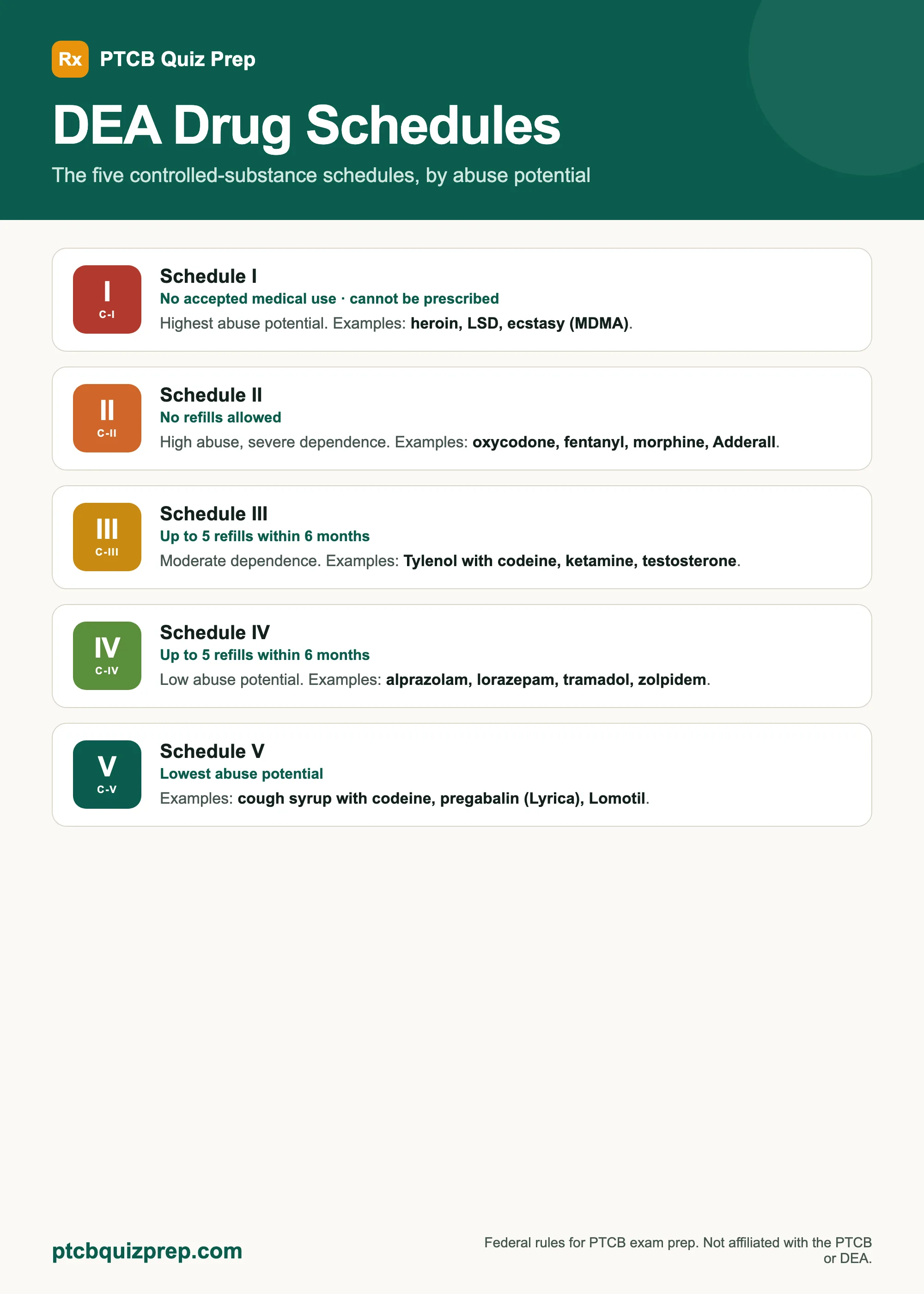
Treat this as rule-recognition practice. Know the DEA schedules cold (Schedule II has no refills; III to V allow up to 5 refills within 6 months), plus recall classes, REMS programs, and pseudoephedrine limits. Our DEA controlled substance schedules chart sets out all five tiers side by side with the defining criteria, example drugs, and refill rule for each, which is the fastest way to stop confusing Schedule I with Schedule II. Remember the PTCE tests federal law only, not your state. Our PTCB Federal Requirements guide lists every rule area this domain covers, and how to calculate a DEA number walks through the check digit, which is the one federal rule the exam asks you to apply as arithmetic rather than recall.
Patient Safety & Quality Assurance (23.75%)
Practice naming the safety cue before you pick an answer. Know the high-alert drugs (insulin, anticoagulants, opioids, concentrated electrolytes), the look-alike/sound-alike pairs and the tall man lettering used to tell them apart, and the error-prone abbreviations. Learn when a technician must escalate to the pharmacist. Two references cover the rest of this domain's reference load: the auxiliary labels list groups every warning sticker by the problem it solves, and the hazardous drugs reference explains the NIOSH criteria and the USP 800 handling rules built on them. To check yourself on any of it without a timer running, the PTCB practice questions with answers set out each question with its explanation in full. Our PTCB Patient Safety & Quality Assurance guide breaks down each of those areas.
Order Entry & Processing (22.5%)
This is where vocabulary, math, and safety meet. Translate the sig into plain English first, then calculate. Know NDC anatomy, DAW codes, and days-supply math. Our PTCB Order Entry & Processing guide maps the full domain. Keep the pharmacy abbreviations reference handy, and our abbreviations quiz and math practice test target this domain directly.
Pharmacy math checklist
Write the setup before you solve, so a reading mistake does not become a math mistake.
For the formulas and worked examples behind each row, see the pharmacy math guide, the math formula cheat sheet, and the measurement conversions chart.
| Task | Setup and what to watch |
|---|---|
| Days supply | Quantity dispensed divided by daily use. Watch directions that change daily use. |
| Quantity to dispense | Daily use multiplied by number of days. Watch unit mismatches. |
| Conversions | 1 kg = 2.2 lb, 1 tsp = 5 mL, 1 tbsp = 15 mL, 1 gr = 65 mg. Most errors are conversion errors. |
| Percentage strength | Write the concentration as a relationship (g per mL or per 100 mL) before solving. |
| Ratio and proportion | Keep units aligned on both sides, cross-multiply, then sanity-check the units. |
| Alligation | Differences on the diagonal give the parts of each strength to mix. |
4-week and 8-week study plans
Use the 4-week plan only if you already know pharmacy workflow and can study consistently. Use the 8-week plan if you are new, working full time, or rebuilding math.
| Week | 4-week plan | 8-week plan |
|---|---|---|
| 1 | Outline, domain weights, Medications, daily math. | Outline and exam basics; build your calendar. |
| 2 | Federal Requirements and Patient Safety. | Medications part 1: names, classes, uses. |
| 3 | Order Entry and mixed practice. | Medications part 2: interactions, storage, safety cues. |
| 4 | Timed full exam, weak-domain review, logistics. | Federal Requirements. |
| 5 | - | Patient Safety and Quality Assurance. |
| 6 | - | Order Entry and Processing. |
| 7 | - | Math intensive and timed mixed practice. |
| 8 | - | Final review, source recheck, test-day readiness. |
Common study mistakes to avoid
- Studying from an old outline. Put the January 6, 2026 outline at the top of your plan and retire notes that conflict with it.
- Memorizing drug names without applying them. Pair each drug with one safety cue or scenario.
- Saving math for the final week. Do short calculation drills every week and log each setup mistake.
- Treating a prep site as official. Use PTCB for exam facts; use independent practice for repetition and explanations.
How to know you are ready
Before you schedule, you should be able to say yes to most of these:
- I can name the four 2026 domains and my two weakest.
- I can explain why each missed answer was wrong, not just the right option.
- I can work days supply, quantity, conversions, and concentration problems without guessing the setup.
- I can finish a timed 90-question practice exam and my misses no longer cluster in one domain.
When you are close, take the full full PTCB practice test under timed conditions to build stamina for the real 110-minute sitting.
Study guide FAQ
How long should I study for the PTCE?
Four to eight weeks for most candidates, depending on your pharmacy background, math comfort, and schedule. Use four weeks only with a strong foundation.
Is the PTCE hard?
It is challenging if you rely on memorization alone. Studying by domain, practicing math weekly, and reviewing every missed question makes it very passable.
Are the top 200 drugs enough?
No. A top-drug list helps with recognition, but the PTCB outline defines the full scope. Use the list as one study tool inside a domain plan.
What math is on the PTCE?
Days supply, quantity, ratio and proportion, percentage strength, conversions, and sig interpretation, concentrated most heavily in Order Entry.
Official sources checked
Exam facts should be confirmed with PTCB. This guide is built from and cross-checked against these primary sources.
- PTCB Certified Pharmacy Technician (CPhT) page
- PTCE Content Outline (effective January 6, 2026)
- PTCB At-a-Glance: CPhT Exam
PTCB Quiz Prep is an independent study resource and is not affiliated with PTCB.